
Data and AI Foundations: From Chaos to Clarity

Across the enterprise landscape, an overwhelming sense of urgency surrounds Artificial Intelligence. Leaders read headlines about autonomous agents and generative tools, then immediately task their teams with deploying cutting-edge models.
Yet in boardroom after boardroom, the outcome is often the same: expensive pilot programs stall, algorithms hallucinate or produce conflicting metrics, and executive confidence collapses.
To unlock actual enterprise value, organizations must move systematically through the stages of data maturity. You cannot deploy predictive intelligence or autonomous workflows on top of fractured data pipelines. High-impact AI isn’t magic—it is the natural, final layer built upon solid data hygiene, architectural discipline, and deliberate governance.
The 10 Stages: Why You Cannot Skip the Ladder

True data maturity progresses systematically across four distinct phases:
Foundations: Clean, automated transactional data collection and reliable operational reporting.
Insights: Financial modeling, structured business intelligence (BI), data warehousing, and descriptive analytics (what happened).
Advanced Intelligence: Predictive analytics (what will happen) and prescriptive models (what is the best course of action).
AI Mastery: Embedded machine learning, automated decision engines, and full AI implementation.
When companies try to leapfrog from messy ad-hoc reporting directly to Phase 4, the classic principle takes over: Garbage In, Garbage Out. Without foundational accuracy, timeliness, consistency, and uniqueness across your records, predictive models and LLMs will merely generate flawed decisions with absolute statistical confidence.
The Architectural Blueprint: Decoupling and Core Integration
To prevent technical debt and vendor lock-in, modern enterprises must enforce two architectural mandates:
1. Decouple the Data Layer from the Presentation Layer
True scalability requires separating where data is modeled, cleaned, and stored (the Data Layer) from where it is consumed (the Presentation Layer—dashboards, BI tools, and LLM interfaces). When your data layer is decoupled and unified, multiple front-end apps and AI agents can query a single governed source of truth without contradiction or drift.
2. Integrate Deeply into Enterprise Workflows (ERP / CRM)
Bolt-on AI point solutions inevitably fail because they lack structural context. High-leverage AI must hook directly into core transactional systems—your ERPs, CRMs, and knowledge graphs. By mapping entity relationships across disparate databases, enterprise knowledge graphs provide the contextual grounding that LLMs and predictive models need to reason accurately.
Proving the ROI: Lessons from the Field
Investing in foundational data isn't an academic exercise; it generates outsized, compounding returns. Across hundreds of enterprise consulting engagements, the impact of getting the fundamentals right is unmistakable:
Real Estate & Asset Management: A multi-billion-dollar asset management firm suffered from internal conflict because marketing, operations, and accounting used conflicting definitions of "days on market." By aligning data definitions and automating the data flow into an enterprise intelligence layer, they eliminated cross-departmental friction. Building upon this clean foundation, they deployed dynamic pricing and revenue-management algorithms—a $50k initiative that yielded over $2 million in incremental annual revenue (a 40x ROI), alongside $100k in saved reporting time.
Healthcare & Life Sciences: Large hospital modernized its donor and financial intelligence architecture, consolidating more than 90 fragmented reports into 10 priority dashboards. Layering predictive donor targeting algorithms onto this clean data reduced advertising acquisition costs by 50%, saving over $100k annually while generating a 10x return on the build.
Manufacturing & Automotive: At Toyota Motor Manufacturing, consolidating siloed data across 30+ disparate sources into an automated real-time KPI architecture reduced operational down time, while paving the way for predictive defect and safety models worth millions.
Here's another use case:

Moving from Defensive to Offensive: The Executive Playbook
Historically, Canadian and mid-market organizations have treated data and analytics defensively—focusing solely on compliance, basic bookkeeping, and risk aversion. But as the performance gap between data-driven and laggard organizations widens exponentially, analytics must become an offensive competitive weapon.
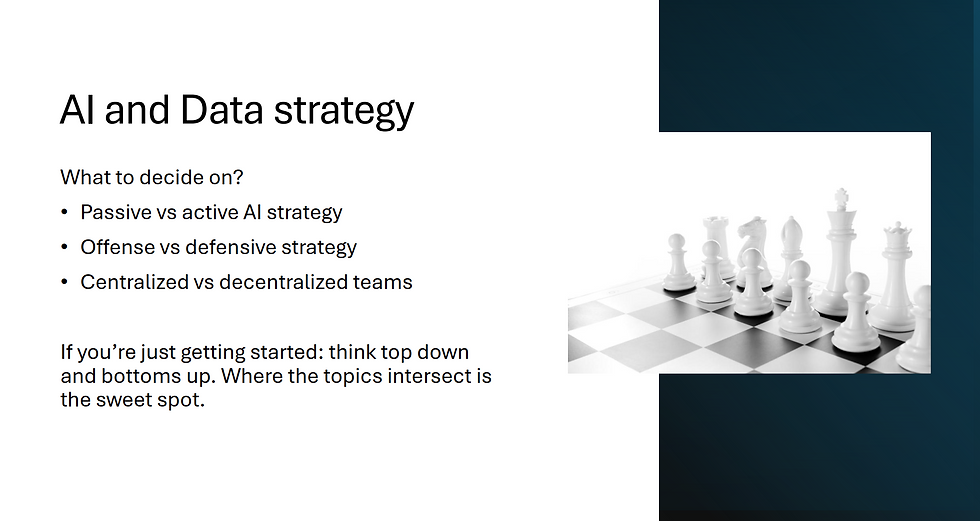
For modern leadership, the mandate is threefold:
Drive the Revenue Side: Automate data intelligence to spot demand trends, optimize pricing, and personalize customer interactions before competitors do.
Ruthlessly Optimize the Cost Side: Automate recurring reporting, streamline invoice audits, and deploy agentic department co-pilots for repetitive workflows.
Invest in People & Governance: Establish clear Role-Based Access Control (RBAC) to ensure proprietary enterprise data never leaks into public models, while providing continuous AI literacy training across every business unit.
AI success isn't about buying the newest software suite. It is about having the strategic discipline to organize your data, govern your assets, and turn everyday operational chaos into clear, actionable value.
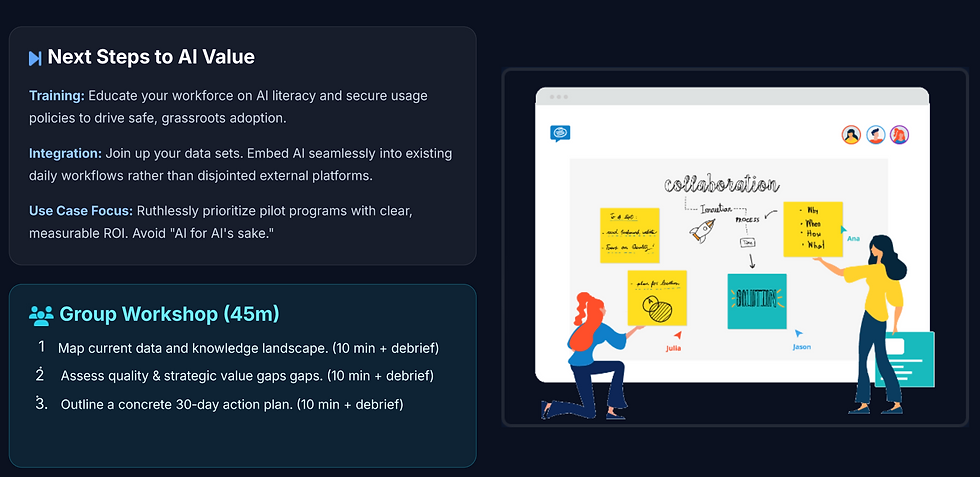
Hers's an exercise you can do with your team to understand the data and value gap.



Comments